Showing posts sorted by relevance for query economic benefit. Sort by date Show all posts

Friday, May 1, 2015

Memo to E. Boochever, Esq; AAB; and Brunswick…

On Expansion:

Recall this passage in Ms. Boochever’s recent op-ed, which we addressed in a recent post:

“Mr. Schaeffer’s interpretation of NNEPRA’s plans for expansion of passenger rail service to other Maine cities is speculative. It is clear that he has never checked his “facts” with NNEPRA or Ms. Quinn.”

We pointed out how later words in her own column stepped all over her assertion.  But our thoughts aren’t ‘probative’ in such matters, nor are we an Esquire.  A retired “Captain of Industry,” perhaps, but not an Esquire.  So we sent our staff out to look for more convincing evidence of our claim, in hopes it would further disprove the Booch’s.

Here’s what we found, and on the NNERPA web site itself: http://www.nnepra.com/sites/default/files/content/images/NNEPRA_Strategic_Initiatives.pdf

image

Friday afternoon is wind-down TGIF time for most of us, and a little humor is always welcomed this time of the week.  So we appreciate these two bullets under the first paragraph above:

• Demonstrate positive economic return and public benefit

• Include a sustainable financial model

Funny how it’s easy to find economic benefit projections prepared by obedient consultants, but no proof of economic return/benefit.  And a complete refusal to engage in collecting such proof.  All the ‘proof’ we collect anecdotally seems to show that net economic return all accrues to Boston. 

Public benefit?  Well at least the Dunbars and others can make 100 or so trips to Massachusetts for a variety of activities.

                    Image result for funny money

Sustainable financial model?  There’s another laugher for a Friday afternoon.  Hey, barkeep, bring us another round of Kool-Aid Jello Shots, will ya?  If the Board, and anyone else in the Downeaster fan club thinks a 50% operating loss is a ‘sustainable’ financial model, we’d sure like to see a full disclosure of their family’s personal finances.  (And by the way, barkeep, we expect a 50% discount on our tab, cause we’re scarfing down these shooters ‘in the public interest.’)

                                       Image result for monopoly money

Would they recommend the Federal Government increase spending until they’re running at a 50% operating deficit?  It’s pretty close to 40% at the moment, but what’s another giant jump in deficits?  Hell, it’s only funny money, and whatever has to be paid back will be paid by the kids and grandkids of this age, long after such wise adults and their courageous commitment to ‘sustainability’ are long gone and forgotten.

What a great governance model, and what a great Board.  Just what you might expect when a governmental agency has it’s board members appointed by the same government that created the agency.

Now as to those plans for expansion, we don’t care whether you call them ‘feeder lines’ or Downeaster expansion, or what.  A NNEPRA run passenger train, regardless of what you call it, is a NNEPRA run passenger train.  And we see plenty of evidence of expanding NNEPRA run passenger train service as a top priority in that Strategic Initiatives summary.

                                Image result for go sell crazy somewhere else

PS: Hey, Emmy; who’s carrying your name forward to replace McEvoy on the NNEPRA Board?

(Ed. Note: we sent this message off to NNEPRA yesterday, and have not received a response)

Could you please provide a link to the Downeaster Service Development Plan referred to on this page: http://www.nnepra.com/projects/downeaster-service-development-plan

On Economic Benefit:

We saw a little news item recently about vacancies in the Merrymeeting Plaza here in Cape Brunswick, the “head of the Downeaster service.”  The report included this factoid:

The overall vacancy rate for retail properties in Brunswick was 16.4 percent in January, according to a presentation by Mark Malone of Malone Commercial Brokers at a recent Maine Real Estate & Development Association conference.

The vacancy rate for retail properties in greater Portland was 3.7 percent, Malone said.

   

How’s that for a great big heaping bowl of Downeaster economic return and benefit?  We were also reviewing some prior posts and archived materials, and came across the conversation we had with Dale King, owner of Brunswick Taxi, who told us ‘the train has hurt us.’  (Wait until you hear the update we have on that subject!)

We have a couple of related thoughts, now that the Jello Shots are taking effect.

                                        Image result for wind sock

First, we think Emily, AAB, and the rest of the Carriage Set should learn how to tell whether the economic winds are blowing resources North or South.  Maybe a wind sock would help; we suggest placing one atop the Maine Street Station.   Here’s some visual symbols of what we’re talking about:


We think of this one as showing the winds of economic activity blowing from the North as local businesses try to hold their ground.


This one is a depiction of the Downeaster Fairy Godmother welcoming the winds of economic stimulus from the south.  Noticed the closed eyes.

Our point is that if you can’t tell which way the winds are blowing, or the suction is pulling, you don’t deserve to be a trusted forecaster of our economic weather outlook.

Here’s another thought, free of charge.  If the Merrymeeting Plaza is starting to flounder as a viable retail center, why not tear it down and build the Amtrak MLF on that site?  It would be right next to the existing tracks, and ready to renovate the siding over to Brunswick Landing.  Hell; the MLF, in stead of being named the Wayne Davis Memorial Maintenance and Layover Facility, could instead be called Brunswick Siding.

There is one other news item of economic note to report.  You may have read that Brunswick now has a “Vape Shop,” where “e-cigarettes” and related products are offered to help those addicted to nicotine find an alternative that is healthier for them and those around them.

Could there possibly be a rail based equivalent for those addicted to the Downeaster and the romance of the rails?  Perhaps a woman’s fragrance; Chanel P42.  Remember the popular men’s cologne Canoe?  How about Diesel? 

The winner of course would be an e-cig that emits simulated diesel fumes.  And makes squeaking and rail clattering sounds, just like the real train.

Then when you ‘light up’ at the Kool-Aid bar, and someone says “hey, girl, what have you been smoking,” you can say “it’s the new Downeaster musk blend.”  You can enjoy it at home, in your car, amongst friends and family, and get the same high.
    

It may not be as romantic as those old steam engine coal smoke emanations, but we hear it has the same health benefits.

Tuesday, April 28, 2015

Welcomed new Downeaster economic benefit data…..

You know we’ve been banging your head against the wall about trying to pry useful, objective data out of locals that would support claims of the Downeaster bringing vast economic benefit to Brunswick and the local area.  And we banged our heads against the town council chamber walls as well, to no avail

We’ve described our failed efforts in a variety of posts, and even issued an open invitation to any and all to submit data that would help make the case.  The most recent posts are these:

http://othersideofbrunswick.blogspot.com/2015/03/finally-some-serious-economic-data-on.html

http://othersideofbrunswick.blogspot.com/2015/04/an-open-invitation-other-side-calls-for.html

The latter one contained this heartfelt plea for help:

Apparently, some knowledgeable experts were able to crack the code, and step forward to help us out.


This state employee, reportedly an expert in passenger rail operations and their contributions to economic development and vitality, appeared before the Brunswick Town Council at last night’s meeting.

While we stayed home to nurse what remains of our nagging cold/flu, we watched most of her performance via live streaming.  If we heard her correctly, she bubbled enthusiastically about how once the MLF is built, and full service expansion is in place between Brunswick and Boston, local residents would be able to catch a train to Boston and take in a Red Sox game, and ‘make it back home that night by train.’

So there you have it: hard facts and promises from an acknowledged and highly praised professional on the economic benefits of the Downeaster.


Perhaps the benefits aren’t accruing exactly where town officials keep saying they are, and won’t even more so once service expansion is complete.

But you aren’t going to begrudge economic benefit to those in other states and cities, are you?

We can’t imagine you’d be quite that petty.  Or would you?

Saturday, March 28, 2015

Finally! Some serious economic data on the Downeaster!

DEPpan

Where do we begin after a week like this?  A week filled, as Walter Cronkite used to say, “with those events which alter and illuminate our daily lives.”  We’ll have to think long and hard about the two key action words he used, but for now we’ll abide them.  Walter, by the way, was a fraternity brother of ours, which depending on your inclinations, means both of us are unworthy of being taken seriously.

The week was filled, as some of you know, with a nearly 12 hour session on Wednesday at the Brunswick Golf Course, where Maine’s Department of Environmental Protection (DEP) conducted a full hearing on NNEPRA’s StormWater Permit Application.  That application pertains to the Maintenance and Layover Facility they propose to build in the “Brunswick West” location nearby the Bouchard Drive in-town neighborhood. 

The session was broken into a very formal court-like process for the involved ‘parties’ that ran from 9am to almost 5pm, followed by an evening session that began at 6pm and ran for two hours or more, during which ‘the public’ could comment on the issue.


Then on Thursday, many of us (from both points of view) traveled to the State Capitol in Augusta, where we sat in on a Legislative hearing for the passenger train idling bill sponsored by Senator Stan Gerzofsky.  Excluding the wait time, this hearing consumed something like 2.5 hours of discussion time.

Your humble correspondent testified at both events, and we’ll be passing along the contents of our testimony in upcoming posts.

                image

Now to the maine subject of this post, as suggested by the title.  You may recall that in past efforts, we did our best to see that an objective study was undertaken by our town, with the help of Bowdoin faculty and students, to ascertain the ‘economic benefit’ of the Downeaster to our perfect, or near-perfect community.  We wanted some data to back up claims by well-known public figures that the train “has already had major benefits for the local economy” and similar assertions.

While the graphic just above doesn’t specifically derive from circumstances such as ours, we found the prima facie subject designation entirely appropriate.  We’ve had any number of local authorities, elites, and attitude formation experts rave about the ‘promise’ of the Downeaster as it relates to putting our community ‘on the map,’ sparking economic development of unbridled depth and breadth.

If you care to review the background on this subject on Other Side, hie yourself here: http://othersideofbrunswick.blogspot.com/search?q=economic+benefit

Sometimes, fate intervenes in the midst of our failures and provides alternate solutions, and that’s what we bring to you today.  Unknowingly, or perhaps unwittingly, various sources provide real insight into our subject, and in the process, blow holes in the widely-accepted articles of faith associated with ‘the promise.’

Let’s begin with this example, in the form of an earnest letter by a local resident to the editors of The Ostrich. The dear lady also testified at the DEP session on Wednesday, essentially reading her letter before the assembled masses.  Read the letter carefully:

In support of the permit

I am writing in support of the storm-water permit application so that the Brunswick Layover Facility can be constructed. My retirement has been enhanced by frequent train trips to Boston to visit museums or enjoy other activities. Addition of a third round trip from Brunswick to Boston would mean that Brunswick residents could enjoy a full day of activities in Boston, including dinner in a fine restaurant and a play or concert and then catch a train all the way back to Brunswick. Looking for my car in a deserted parking lot at the Portland station after the last train arrives at 1:25 a.m. and then driving home to Brunswick alone is not an experience that I wish to repeat.

Alison Johnson
Brunswick

What the letter does, of course, is to document the exact opposite of economic benefit to our local economy.  Instead, it articulates ‘the sucking sound’ the Downeaster represents as it pulls discretionary dollars from local residents and takes them to points south to stimulate the economy in those destinations.  And it asks for more options and service to make hauling dollars south more convenient.

Moving on, let’s look at the testimony of Charles Dunbar, a retired Ambassador and diplomat, who lives in the historic Pennellville area of our nearly perfect town.  We believe his spouse testified at the DEP hearing, though we have no materials at hand documenting what she had to say.

We do, however, have a copy of the remarks Mr. Dunbar submitted to the Transportation Committee of the Maine Legislature on Thursday.  Here it is:

Testimony by Charles Dunbar at the LD 439 hearing on Thursday, 26 March 15

My name is Charles Dunbar, and I love (live?) in Brunswick. Thank you for giving me the opportunity to testify about my grave concern that the bill you are considering may cripple the present operations and future development of the great service provided to the people of Maine, New Hampshire, and Massachusetts by Amtrak's Downeaster.

I begin by expressing my high esteem for NNEPRA, its executive director Patricia Quinn, NNEPRA's staff, and the Downeaster crews, all of whom I have grown to admire from the vantage point of a frequent Downeaster rider. I have watched with growing respect as they surmounted the adversity of the past two winters, unscheduled track repairs, and delays caused by other trains to keep the service healthy and growing.

I recently wrote to Ms. Quinn to commend the imagination and ingenuity of Conductors Peter White and Rob deVilleneuve for finding ways of getting 70 or so Freeport and Brunswick passengers home when a freight train broke down and blocked the track between Portland and Freeport. Although occasionally inconvenienced by being unable to travel on a growing number of full trains both to and from Boston, I am pleased at the triumph this represents for those directly involved and for our state as a whole.

In short, the Downeaster has been an integral part of my life for the past four years, and I have enjoyed almost every minute of the 71 trips Amtrak recently informed me I had made between Brunswick and Boston in the past year. The train facilitates my teachig (teaching?) at Boston University, my access to my doctor and to the Beth Israel Deaconess Medical Center, where I am being treated, and my wife's and my travel to Boston to visit family and attend cultural events.

My "where-the-wheels-meet-the-steel" Downeaster expertise does not extend to the bill you are considering today, but I cannot see how it could do anything but harm to the Downeaster. I thus hope strongly that it does not become law.

If you’d like to know more about Mr. Dunbar, you can find it here:  http://www.bu.edu/pardeeschool/profile/charles-f-dunbar/

It’s clear, of course, that with 71 round trips in the last year between Brunswick and Boston, Charles is highly dependent upon the Downeaster.  That’s an average of almost 1.5 round trips per week.  This ‘integral part of his life’ allows him to work, get health care, visit family, and attend various ‘cultural events.’

Under the circumstances he describes, one might wonder why Charles and his spouse live in Brunswick, since all their meaningful activities take place 160 miles south.  We can only guess what economic benefit this generates for the Boston area, and what loss of local economic activity it represents.  And we can only guess, in the same fashion, why Charles and his bride haven’t taken up residence in greater Boston.  Seems like they’re down there most of the time anyway, for life’s most important pursuits.  Why not clean up their existence by eliminating all that commute time?

DSC_0200

Next item: you may or may not remember the “Chain Station,” a bicycle shop that opened a few years ago in the building on Union Street adjacent to the ‘long term parking lot’ provided by the town for Downeaster travelers.

As we understand it, the duo who opened that business did so largely on the expectation that the massive influx of tourists predicted by NNEPRA would generate considerable demand for bike rentals, and that a location nearby the train station would be a winner.  Apparently their expectations were unfounded, and now someone else has decided to run a ‘bike and ski’ business out of the building.  We’ll see, of course, how good their judgment was in making whatever investment they’ve put into their operation.

We wish them the best.  But we’ve seen nothing so far to indicate that basing your economic health on Downeaster train service is a solid proposition.

As a matter of fact, after the Poppycock’s had a casual dinner at a packed ‘venue’ in a nearby town last night, we drove through the Maine Street Station area, at about 8:30 pm…on a Friday night, no less.  We noted a significant number of parking spots available in the general area, though we can’t say definitively what this means.  We do know, however, that the parking situation in our chosen dinner spot was far more congested.

We know…just anecdotes.  But since our betters in town government won’t get behind an effort to come up with more substantive information, it’s all we have, right?

We’ll close with the report on the Wednesday hearing filed and posted by TrainRiders Northeast on the their web page.  As we understand it, the ‘webmaster’ who filed this report is one Bill Lord, a retired TV journalist type who worked behind the scenes for Cronkite, Dan Rather, and others.  He may even have spent time on camera/on screen.

Here’s part of the report Bill filed on the Wednesday hearing:

Marathon DEP Hearing on NNEPRA's Storm Water Runoff Permit

Published on Thursday, 26 March 2015 13:07
Written by TRN Webmaster

It was an all-day event as the DEP held extensive sessions on NNEPRA's Storm Water Runoff Permit request. The permit is required for the construction of the Downeaster's Brunswick Layover Facility. It began at 9:00 a.m. and ended at 8:00 p.m. (with some lunch/dinner breaks). This was the first such public hearing the DEP has ever organized for this type of permit.

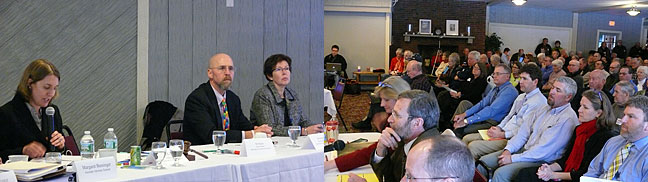
The evening public session, held at the Brunswick Golf Club, brought out nearly two hundred advocates - against and for the permit. Those against feared disruption of their neighborhood due to alleged pollution and flooding and those in favor disputed their fears and emphasized the economic benefits of the expansion

DEPFour

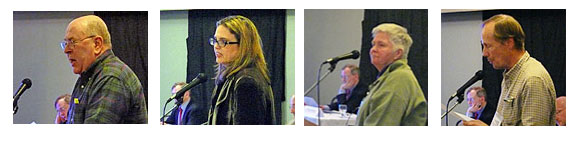
The photo strip just above contains a candid shot of your faithful correspondent testifying at the hearing, along with another ‘opponent’ of the SWPA permit, and two supporters of the permit, including the beloved NNEPRA supporter we’ve nicknamed ET.  Hopefully you can tell which one of the images is your reporter.

Bill Lord, the reporter, did a horrible job of describing the public session in his last paragraph.  He pretty accurately captured the essence of the ‘against’ contingent, but he completely blew it on the ‘for the permit’ speakers.  They offered not a single bit of data on economic benefits, and instead waxed emotional about how much they love the train, and how much it means to everyone.  No evidence, no facts, no logic.  Just rhetorical homage to the diesel dust spewing behemoth that spends so much time in our midst.

If this is the kind of reporting integrity Bill Lord brought to the news on CBS in his years with the network, we can only mourn the credibility we ascribed to them in our naïve young adult years.  Bill has obviously found, in TRNE, a perfect application for his spinning of reality, complete with video and photographic backup.


Not bad, we suppose, for a project in which taxpayers have invested well over $100 million, and that is looking for another $30 million plus to ‘optimize service.’  Not to mention the future investments required to expand service to NYC, Augusta, Lewiston-Auburn, Bangor, Rockland, and anywhere anyone else wants the choo-choo to come to town.

So what if the service currently runs at a 50% deficit, needing an annual transfusion of $8-9 million from elsewhere to keep the trains running.  This is, after all, economic stimulus and economic benefit. 

Why can’t you see that?

We’re thinking that’s enough for tonight, and for you to assimilate and digest, as uncomfortable as that may and should be.  Make sure you have some Pepcid or Nexium on your nightstand.

Trust us; there’s much more to come, and the volume of reporting ahead of us is growing day by day, almost faster than we can comprehend it.

It won’t be pretty.

Just like us.

Monday, November 17, 2014

Downeaster Economics vis-à-vis Brunswick: Gruber theory right before your eyes?

Maybe you recognize the individual pictured above, maybe you don’t.  Regardless, based on recent news, we think a very good case could be made that he is the ‘poster child’ for NNEPRA and it’s Downeaster; it’s relationship to Brunswick; and the BDA as well.

The individual pictured, the suddenly very high profile Professor Jonathan Gruber of MIT, embodies several principles that are apparent in our own midst, particularly as it relates to the Downeaster.  One, “lack of transparency is a huge political advantage.”  Two, the end justifies the means.  Three, the average American is stupid in matters of economics.  Four, if the truth were known, the program could not survive. 

Which, in the notation of Gruber economic theory, can be represented by this expression:

1 + 2 + 3 + 4 = you’ve been had, and you better like it.

Or symbolically, with this iconic image:


We could go on and on having fun with this, and we no doubt will before long.  As the hours go by, we’re feeling remarkably blessed that Professor Gruber has surfaced to personify our circumstances so perfectly and succinctly.

The above is by way of introduction to the fact that we spoke to our betters on the Brunswick town council tonight on exactly this subject – the economic consequences of the Downeaster for our local economy.  Herewith the text of our statement:

  • Good evening. I'm Mr. Schaeffer.

  • I'm here to talk about an idea I had; an idea involving the Amtrak Downeaster, Bowdoin College, and Brunswick

  • As background, NNEPRA (Northern New England Passenger Rail Authority), the state agency that operates the Downeaster, was created by Maine State Law in 1995.

  • The law mandated creation of the agency, directed that it establish passenger rail service, and obtain the funds to do so by whatever means it can find.

  • The law did not call for assessment before hand of public transportation needs; nor analysis of possible methods for meeting any credible needs; nor the creation of a viable, sustainable economic model for implementing and operating this service.

  • It simply directed that passenger rail service be established, without benefit of due diligence. As such, NNEPRA and the Downeaster are a fine example of government legislation that creates a solution, and then sends it off in search of a problem that may or may not exist.

  • It's almost as if a young Professor Gruber was involved in it's creation.

  • The Downeaster has been operating between Portland and Boston for more than ten years; the extension between Portland and Brunswick has been in operation for two years.

  • The service to Brunswick has received glowing praise, especially as regards its “great economic benefit” to our local economy. I'm not aware of any objective data to support that assertion. Brunswick residents provide a subsidy for the operation of roughly $100,000 a year on the debit side, or in the range of $300 a day. Various interests and community leaders are bursting with glee at plans to increase service to Brunswick from two round trips a day to five.

  • On another dimension, we are the home of Bowdoin College, a respected, highly selective institution with an Economics Department. And a stated commitment to service learning and engagement with the community. Brunswick is proud of its relationship with the College, which among other benefits, resulted in this building becoming our town hall.

  • To this observer's thinking, the utter lack of objective economic benefit data for the Downeaster provides an opportunity for a win-win town-gown collaborative effort. College students studying economics could engage in a real world study of the local economy, and the town could gain economic insights to underpin future decisions about Downeaster related policy and spending.

  • Points to consider in any such study include these.

    • A significant number of local businesses offer no attraction to visitors, and would seldom if ever benefit from their travel here on the Downeaster. I doubt anyone comes to town on the train to do banking, get their hair done, their shirts laundered, their eyes tested, or their health tended to at a walk-in clinic.

    • That 'long term parking lot,' if used as intended, holds cars of folks taking their discretionary dollars to points south to spend, rather than spending them locally.

    • Claims by any local business that they gain meaningful patronage from train-riders must be balanced by the fact that no-one can measure the offsetting opportunities lost because area residents take their patronage out of town.

    • For example, a local Inn manager says in a recent video that he attributes 400 room nights a year to the train. That's slightly more than one room per night, which is next to nothing. But how many room nights were booked elsewhere because of the same train, by area residents traveling south?

  • We're quick to mention dollars wafting in on breezes blowing to the north, but fail to acknowledge dollars leaving the area on winds blowing south. There is, surely, a sucking sound, but identifying the specifics is uncomfortable, if not impolitic.

  • Another truism associated with our circumstances is that someone coming to town ON THE TRAIN does not mean they come to town BECAUSE of the train. Diversion from one travel mode to another yields no economic benefit.

  • The lack of specificity in ridership reporting only makes things worse. Virtually every rider is on a round-trip, some originating here, and some originating at points south. So to begin with, one traveler shows up as two in ridership figures.

  • One wonders what effect the Downeaster has on Concord Coach ridership, a service established long before Amtrak started coming to town. That bus service, by the way, is far more economical, flexible, convenient, versatile, and environmentally friendly than the train.

  • Let's get to the punch line. In view of the above, I proposed the idea of a collaborative 'town-gown' economic study effort on Downeaster local consequences; I even made some notes on a 'framework' for the study, and suggested unique parameters that would apply.

  • My hope was to make the proposal a formal agenda item for council discussion and a vote. For the first time in all my years coming before you, I talked to four councilors about the possibility of sponsoring a motion so it could come before the council and the public. None signed on.

  • So here I am, with a dead-letter idea, left to ponder why. Are those I spoke to unwilling to face what could be disappointing realities? Has too much personal capital been invested in the groundwork for Maine Street Station and the Downeaster service? Are you fearful of offending various town leaders, of both the official and unofficial sort? Are you concerned that developing a factual basis for future policy and funding could cause NNEPRA to discontinue service here?

  • More to the point, are you afraid of the truth? Or that such a study could not be conducted objectively? If so, what a sad story that tells about elected leadership, and what a pall it casts upon other discussions of governance that come before this body. Not to mention the perceived academic integrity of Bowdoin.

  • In closing, as someone said recently, lack of transparency is a huge political advantage, and this situation may be as simple as that.

  • Thank you. And I hope you have a chance to read the brief material added as an Appendix.

Appendix to Statement:

The points below are excerpted from: http://ti.org/antiplanner/?p=9664#comments

1. Transportation spending can stimulate economic development only if it generates new travel that didn’t exist before. Transportation projects that merely persuade people to change from one mode to another or one corridor to another might influence where economic development takes place, but will not produce any net additional development.

(A corollary to this rule is that the dreaded “induced travel” that comes from building new roads in congested regions is exactly the kind of desirable result that should come from transportation spending. Such new travel creates new economic opportunities for landowners, employers, and entrepreneurs that are the best indication of whether a transportation project was worthwhile.)

2. Transportation spending will generate new travel only if the project provides transportation that is faster, cheaper, and more convenient than what existed before. Projects that reduce people’s costs (both in hours and dollars) will encourage people to travel more.

3. Most rail transit, and virtually all streetcars and light rail, provide transportation that is slower, more costly, and less convenient than the alternatives. Even if most of the costs are paid by taxpayers, rather than travelers, the higher taxes place a burden on the community that slows economic growth.

4. Even where rail transit is paid for by federal taxpayers (thus relieving local taxpayers of the burden) and carries huge numbers of people (which almost requires that it be subways or elevateds, not light rail or streetcars), any new development stimulated by the transit project will probably be limited to the downtown area (see p. 3). The rest of the region will end up suffering because even if the feds pay for construction, locals will probably have to pay high cost of maintaining the rail line.


That’s it for tonight, students.  Make sure your slide-rules are well waxed, so you can follow the next class on precision in economic analysis.  And don’t worry, Professor Gruber has already declined our invitation to be the visiting lecturer.  Seems he was worried he wouldn’t be able to get a seat on the Downeaster because it’s ‘sold our farther down the line.’ 

But he did send along his calling card:


Oh, and if you’re wondering what the reaction from the council was, you can watch the video once it’s posted.  In a word, a perfunctory comment we were already aware of.

Saturday, December 13, 2014

An Ostrich Op-Ed, challenging Brunswick “leadership”


As we told you before, we’re into the holiday season break.  So take this offering plain and simple; the Ostrich ran it a day ago (Friday, 12 December).

=================================================================

Afraid of Downeaster Truth?

BY PEM SCHAEFFER

The Amtrak Downeaster has been operating between Portland and Boston for more than 10 years; the extension between Portland and Brunswick has been in operation for two years.

The service to Brunswick has received glowing praise for its “great benefit” to our local economy. While no objective data can be found to support that claim, Brunswick taxpayers directly subsidize the service to the tune of $100,000 a year, or $2,000 a week. Community leaders are bursting with glee at plans to increase service to Brunswick from two round trips a day to five.

Northern New England Passenger Rail Authority, the state agency that operates the Downeaster, was created by Maine State Law in 1995 during the King administration.

The law mandated creation of the agency, directed that it establish passenger rail service and obtain the funds to do so by whatever means it could find. The law did not call for assessment beforehand of public transportation needs; nor analysis of alternatives for meeting any credible needs; nor the creation of a viable, sustainable economic model for implementing and operating this service.

It simply directed that passenger rail service be established, without benefit of due diligence. As such, NNEPRA and the Downeaster are a perfect example of government decreeing a solution, and then sending it off in search of a problem that may or may not exist.

Brunswick is home to Bowdoin College, a respected, highly selective institution with an Economics department. They are committed to service learning and engagement with the community. Brunswick is proud of its relationship with the college, which among other things, resulted in the McLellan building becoming our town hall.

The absence of objective economic benefit data for the Downeaster provides an opportunity for a win-win town-gown collaborative effort. College economics students could evaluate the local economy, and Brunswick could gain economic insights to substantiate future decisions about Downeaster related policy and spending.

Accordingly, I proposed a collaborative ‘town-gown’ economic study of local Downeaster consequences. I drafted a ‘framework’ for the study, even suggesting tailored parameters that might apply.

Points to consider in such an effort include these: l Many local businesses offer no attraction to visitors, and would seldom if ever benefit from their travel here on the Downeaster. I doubt anyone comes to town on the train to do banking, get their hair done, their shirts laundered, their eyes tested, or their health tended to at a walk-in clinic.

  • Claims by local businesses of meaningful patronage from train-riders must be balanced by the fact that no-one can measure the offsetting opportunities lost when area residents take their patronage out of town. There is, surely, a suction effect carrying dollars south, but identifying the specifics is uncomfortable, if not impolitic.
  • Someone coming to town on the train does not mean they come to town because of the train. Diversion from one travel mode to another yields no economic benefit.
  • Lack of specificity in ridership reporting is troubling. Virtually every rider is on a round-trip, some originating here, and some originating at points south. One traveler shows up as two in ridership figures.
  • Downeaster effect on Concord Coach ridership is unknown. This service began long before Amtrak came to town. The bus service is far more economical, flexible, convenient, versatile, and environmentally friendly than the train.

My hope was to make the proposal a formal agenda item for council consideration and a vote. I spoke with four councilors about the possibility of sponsoring a motion so it could come before the council and the public. None signed on to do so. One spoke with a Bowdoin faculty member, who suggested grants would be necessary, it could not get underway before next summer, etc. This typifies bureaucratic inclinations to turn simple questions into grand pursuits, creating a ‘too hard’ perception.

Hence, the proposal is a ‘dead letter,’ and I can’t hep but wonder why. Are those I spoke to unwilling to face what could be disappointing realities? Has too much personal and taxpayer capital been invested in the groundwork for Maine Street Station and the Downeaster service? Are they fearful of offending various town leaders, of both the official and unofficial sort? Are they worried that developing a factual basis for future policy and funding could cause NNEPRA to discontinue service here? Is there a council Svengali who nixed the idea?

More to the point, is official Brunswick afraid of the truth? Or that such a study could not be conducted objectively? If so, what a sad story that tells about elected leadership, and what a pall it casts upon other discussions of governance that come before this body. Not to mention the perceived academic integrity of Bowdoin.

In closing, as someone said recently, lack of transparency is a huge political advantage, and this situation may be as simple as that.

Pem Schaeffer is a retired Defense Industry Business Development Leader. He blogs at http://othersideofbrunswick.blogspot.com.

===============================================================

Technorati Tags: ,,

Tuesday, April 7, 2015

An Open Invitation: Other Side Calls for Help With Community Enlightenment

         Image result for formal invitation

Here on Other Side, we like to say we have an insatiable thirst for knowledge.  Or as others might suggest, an insatiable thirst.

We try to get to the bottom of any stories we pursue and report on.  We wish we could say we go after the top of the stories, but here in Brunswick, chasing after the facts more often than not leads down, not up.

As you know, in view of the widespread claims by elected and unelected community ‘leaders’ that the Downeaster is a marvelous stimulus to local economic fortunes, we’ve proposed and written about a ‘town-gown’ collaboration to put some serious rigor into determining the veracity of these assertions.  We figure that demonstrable, quantifiable, and carefully documented benefits could only boost support for the already wildly popular passenger service.  Perhaps even drive ridership levels above the current 10% or so average use of capacity, and provide tangible evidence of ‘widespread demands for expanded service.’

For reasons we can’t quite discern, our calls for such objective study have fallen on deaf ears.  Not a single town councilor we approached was willing to go publicly on the record in support of such a proposal.  And our bloviating here and in The Ostrich have similarly yielded a nullity in response.  It must be, we gather, that our suggestion rises far above the level of rocket science, and that necessary skills are simply unavailable in our perfect little town with its perfect highly selective college.


Lucky for us, whether they realize it or not, some members of the local carriage trade have provided useful economic data in the form of their own use of Downeaster service.  We refer to Ms. Alison Johnson and Ambassador Charles Dunbar, who publicly proclaimed their substantial economic activities stimulated by the availability of the Downeaster in Brunswick.   We wrote about their glowing accolades in this recent post: http://othersideofbrunswick.blogspot.com/2015/03/finally-some-serious-economic-data-on.html

We realize that most breakthroughs in human knowledge, such as we hunger for in this instance, often begin with an unrecognized spark of inspiration that arises serendipitously.  We suspect this is what we have before us, and we are more than willing to honor the sparks in this story by naming the new body of knowledge the “Johnson-Dunbar Theory of Passenger Rail Economic Abundance.”

               Image result for please contribute

Keeping with the unselfish expressions offered by Johnson and Dunbar, we come to you tonight to welcome your own personal messages of economic benefit.  Personal or business related, we will carry your testimony here.  While our main purpose is to seek the contributions of each and every individual who has derived economic benefit from the Downeaster, we know a specific organization has been created to formally herald the enormous consequences for our community. 

That organization is ‘All Aboard Brunswick,’ or AAB for shortening.  We suggest again that their choice of names may send the wrong message, but who are we to question the compelling arguments they put forward?


Given their unique stature in this profoundly consequential public square discussion, we think this very special, personalized invitation fits the circumstances, and we hope you agree.  It all ties in with their devotion to the precise details of quality of place and placemaking.

So, everyone, how about getting on board and submitting your raw data inputs to our economic data collection process?

Or as they say down south, “y’all come, now, heah?”  If we get enough submissions of substance, we might even approach cognizant officials to see if they’ll sponsor a special train ride for contributors.

Sunday, July 26, 2015

Brunswick’s Gaga Ladies and the Romance of The Rails….

(Editor’s note: cumbersome as it may be, we ask readers to understand the term “Lady” and “Prince” to have both singular and plural meanings in our story.  The indefinite nature of each, and a way to express it would detract, we fear, from the telling of the tale.)

Herewith an allegory for Brunswick.  The story has had an inconceivable conception, complicated gestation, and problematic delivery.  As you’ll hear in our telling, if you stay with us until the end (of this tale, that is.)  We’re hoping to stop our troubled pacing over it all, and move on to other things.


Remember the movie Romancing the Stone?  That’s what came to mind as we first thought about this post.  We decided that whether we played off that theme or not, ‘romancing’ should have a leading role in our story.

Here we are then, with a love tale of sorts, symbolic yet all too real, in three parts: the romancing and courtship; the proposal and wedding; and finally, the wandering eyes and broken vows that signal failure of the union, and steadfast denial of the truth.

                   Ladies of Brunswick

Our story revolves around Ladys of Brunswick, the beguiling beauties who we sometimes use to symbolize looking for love in all the wrong places.  They have a penchant for going gaga over the ministrations of various Prince Charmings, of whom there are plenty vying for their attention.


Sounds exciting and spellbinding, doesn’t it?  And it might be so, if their swooning was fictional, instead of all too real in the sense of long-term consequences for those who must pay the price of their ill-considered dalliances.

Bare with us as we sit around the proverbial camp-fire and tell our story.

The Romancing and Courtship:


It all begins when Lady Brunswick hearing of a wandering Prince Charming seeking fair damsel to impress with great and glorious promises.  Not wanting to reveal his plans too early, and become plighted only because of these proposals, the Prince disguised himself as a Knight of community economic benefit.  Should fair damsels show interest, the Prince would ride in triumphantly upon the great steel steed called Amtrak, and sweep them into his arms.

The Prince first visited town with wondrous tales of glories to come.  Encouraged by the damsel’s fluttering eyebrows and outreached hands, he continues to beguile the ladies with his charms.

He cites the learned works of various expert professionals who promise economic ecstasy if only all will succumb to his temptations…..such as these glorious projections for the year 2015 A.D.:

     image

and this as well….both from EDRG MDOT Study 2005:

EDRG 2005 MDOT Study snip 1

Sensing hearts a-twitter, the Prince offers further enticements of even greater economic glory from legendary wizards of TOD from far yonder lands, for generations yet to come (CNT AmtrakDowneasterOverviewofProjectedEconomicImpacts2.pdf):

CNT-NNEPRA 2008 Snip 4

…and this, which causes fainting spells among fair damsels….

CNT-NNEPRA 2008 Snip 3

The Proposal and Wedding:

The Lady of Brunswick, completely Gaga over these oaths of great blessings upon the community, convinces town fathers to gather up her dowry in preparation for offering to the Prince, whose charms have left her in his thrall.

Heart palpitating, the swooning Lady beseeches Prince Charming to show himself, and he does, aboard the great steel steed from lands to the south.


The Prince ask for the Lady’s hand with a prodigious proposal:


It includes housing for the court of the Lady:

image

Soon enough, the dowry is announced (http://www.greatamericanstations.com/Stations/BRK…)
In 2006, the Brunswick Town Council accepted a master plan recommending redevelopment by a private entity, and the following year, JHR Development was selected to lead the project. According to the conditions for development, 1,200 square feet had to be reserved for a future train station.
The project was divided into three parts. Phase I, which included the Bowdoin College Store and the building containing the Visitors Center, offices and retail, began construction in winter 2008. They were finished and occupied by fall 2009. Station Avenue, connecting Maine and Union Streets, was also cut through the site south of the proposed buildings. Phase II began in fall 2010 when ground was broken for the 52-room Inn at Brunswick Station. An office building was also constructed, and both projects were open by late summer 2011. Phase III will consist of a residential building with office and retail space on the ground floor. All of the buildings echo traditional New England architecture through the use of clapboard, shingles, multi-light windows and gables. Through a property exchange with Bowdoin College, the town plans to consolidate its administrative offices in an existing building directly southwest of Brunswick Station.
As of early 2012, public funding for Brunswick Station amounted to approximately $5.2 million obtained from the following sources: $750,000 through the EPA Brownfields Program; $902,500 from the Economic Development Administration of the U.S. Department of Commerce; $300,000 in Community Development Block Grants from the U.S. Department of Housing and Urban Development; $350,000 from Maine’s Municipal Investment Trust Fund, established by the state legislature to provide financial assistance for the design, construction and improvement of public service infrastructure and downtown renewal projects; $2.25 million in municipal bonds; and $668,594 expended by the town to acquire the property. The town government estimates that these public funds have leveraged more than $25 million in private investment by the developer.
Satisfied that he will prosper from the generosity of the fathers, the Prince prepares his proposal for Lady Brunswick.  And it is beyond everyone’s wildest imagining; the marriage is arranged and takes place.   All appears blissful.

image

Sadly, neither the Lady nor the town fathers insisted upon pre-nuptial agreements.  How could they, when it might risk bestowal of such wealth and blessing upon their ancient and humble village?  Lacking such assurances, none seemed to notice the breaking of the vow professed in June 2011 (http://mssbrunswickme.blogspot.com/):
Planning for Phase III, a 16-unit condominium complex (Noble Street), is underway. The condos will feature one-floor living in a secure building with easy access to beautiful downtown Brunswick. Call now to reserve and design your unit!
For more information, please call Mike Lyne at 207-729-0166 or visit http://www.brunswick-station.com/.
image

Nor that three of the initial tenants (four, if you include Best Buy), couldn’t survive the extreme public demand for their offerings.

When romance is in the air, such trivial details get lost in the euphoria of great economic benefit wherever one looks.  ‘Rail’ spelled backwards is liar it turns out, but no once seems to notice.  Just as backwards parking spaces, evident in the plans above, have been forgotten.

The Wandering Eyes and Broken Vows:

While others may not have noticed, your correspondent was rocked back on his proverbial heels when we came across this recent news item, published here:
Five condominium buildings are proposed along the Kennebec River in Bath, on the site of the historic and vacant "Coal Pocket" property.
By Alex Lear, The Forecaster
Posted June 17, 2015, at 3:07 p.m.
Last modified June 17, 2015, at 10:29 p.m.

BATH, Maine — The Bath Planning Board on Tuesday unanimously approved the development of five condominium buildings along the Kennebec River, on the vacant site of the historic “Coal Pocket” property.

JHR Development — which has projects that include Brunswick Station and the Mid Coast Medical Group center at 108 Centre St. — received site plan, developmental subdivision and historic district approvals for the project.
Forty condominiums will be developed in five buildings of eight units each, according to a June 11 memo from planning director Andrew Deci to the planning board. The first floors will have interior parking. Two buildings will have frontage on Front Street, and two on Commercial Street, while one will be between a Sewall oil company building and the riverfront.
Observant as we are, this report caused us to become even more sensitive to local circumstances than we normally are.  So we’re going to bring this discussion to a conclusion with a ‘photographic essay’ that makes our larger point more poignantly than any words we might choose.
 
Feast your eyes, then, upon these signs of ‘great economic benefit,’ wherever you might look:

DSCN0566DSCN0580DSCN0586DSCN0585DSCN0584DSCN0583DSCN0582DSCN0581DSCN0579DSCN0578DSCN0577DSCN0576DSCN0575DSCN0574DSCN0573DSCN0572DSCN0571DSCN0570DSCN0569DSCN0568DSCN0567
DSCN0547 DSCN0548
DSCN0551 DSCN0544

As much as the world, and in particular, Brunswick’s symbolic Lady Gaga, love happy endings, we don’t appear to have one here, do we?  Some ladies can be so Gaga they never admit the Prince has jilted them for another (or is it tilted?)


Like most things in our perfect little town, though, it really doesn’t matter.  Because the proof is in the pudding, not in the poetic imagery of the recipe, or the fanciful garb of the chefs.

The question we’re left to ponder is what the real ending to the story will be.