Saturday, May 17, 2014

Is there trouble in “Perfect?”


Could it be that mere months after the ‘new directions’ episode leading to the departure of former, now nearly forgotten Mr. Manager, new trouble is bubbling in our communal cauldron?

Only the shadow knows, and we don’t think we’ll bother to ask him to check in, since every request in the past has ended up in nada.

If you’re wondering why we even raise such a possibility, wander no further than the passage just below in the recent Forecaster lead article,  under the headline “School chief balks at request for 4th school option.” 

The School Board's desire for another option to ease elementary school overcrowding prompted a sharp rebuke Wednesday from the superintendent of schools.

"Frankly, the indecision of the board is creating a very difficult, almost hostile work environment for us," Superintendent Paul Perzanoski said. "Please, make up your mind, and do it soon, because my staff and I have really had about enough."

The board has been debating the matter for the better part of two years.

Perzanoski made his comments shortly before the board voted 5-4 to gather information on splitting up the student population to create two kindergarten-through-fifth-grade elementary schools.

We’re  pretty certain Super PP isn’t a pitcher, at least in the literal sense, so we’ll be extra vigilant to see if this is an iceberg tip revealing itself, or simply sparks from a school train hitting a stretch of out of spec rails.  Emphasis above is ours, editorially speaking, but reflects the rhetorical mood of Mr. Superintendent, we think.

Given the bumpy road ahead in planning for $25-50 million in new school construction, things should only get more ‘interesting.’


So we should all be listening for the whistle telling us the local tea kettle is aboil. 

Even you, Councilor Wilson.

Monday, May 12, 2014

When what to our questioning eyes should appear….

My goodness!  How the look of the Downeaster can change with the seasons!

traxck geometry car 3 may 14

track  geometry car 2 may 14

The photos above were taken today in the ‘historic rail yard area’ adjacent to the Bouchard Drive neighborhood in Brunswick (or ‘West Brunswick,’ as Saint Wayne of TRN calls it.)

We don’t know if the equipment made it all the way to Maine Street Station, but we hope it did, so that as many folks as possible are ‘up to speed’ (to use an ironic term) on what’s going on following the discovery of ‘unexpected’ track infrastructure problems along 27 miles of track at 25 different locations.


Try as we might, we couldn’t find any updated information from the two primary boosters of the Downeaster, both of whom have ample access to and control of communications channels.


We did, however, find these interesting reader comments on an industry publication website:

MEL & MO MILLER from CALIFORNIA said:

Enjoy your bus ride, Bobby!

MARK SHAPP from MASSACHUSETTS said:

So no one at NNEPRA picked up on the vulnerabilities of of these sections of the ROW when the route was being upgraded preparatory to Downeaster startup? Or did they and (sic) just hope Winters would never get as bad as the last one? Or were they aware and hoping a program aimed at fortifying these sections would some day magically appear. Either way it's pathetic.

I'm not convinced Patricia Quinn and her minions at NNEPRA know what they're doing. Remember, this is the same outfit who built the Brunswick extension without first putting down the foundation, namely a Brunswick maintenance base. So the extension had to open with a paltry two trains in and the same number out, 12 hours apart. That's not what the Brunswick, and I suspect also the Freeport, communities expected.

And there is still no hope for the Brunswick maintenance base nor is there a source for new equipment for any service expansion even between BOS and POR where frequencies are, at best, disgracefully thin.

And Pan Am Railways was and is probably not the most reliable partner a passenger carrier could have. All the more reason for NNEPRA to have been on its toes.

There is something obscene about Helena Williams being fired for doing her job well while Patricia Quinn keeps hers in spite of continued screw ups.

If the bus line (Concord Trailways?) that operates between BOS South Station and the POR Intermodal facility adds frequencies to fill the void Downeaster has created, it could be the end of what could have been a model HrSR operation.

ROBERT J MCGUIRE from MAINE said:

I think my Wednesday trip to Boston will be by bus.

So we’ll issue this gentle reminder to to let those involved know we have an insatiable thirst for knowledge (and other things as well.)


Oh, and one more thing.  Perhaps you read the news about the trackside fires on the stretch of track south of Portland.  Reports say a Downeaster train was not involved in sparking the fire.

We’re no expert in such matters, but it seems to us that a fire could be caused as much by track as by a train.  The track has it’s own geometry, specifications, and tolerances.  As do the trains themselves.

We would think it possible for ‘out of spec’ track to cause a problem when one train goes by, but not another, because the two trains react differently to the track problems.  In essence, one train, because of it’s individual peculiarities, could be more forgiving of misaligned track than a second train.

You can read about the track side fires at the link shown below. This was no trivial event, by any stretch of the imagination, or spin from those in positions of ‘authority’ and ‘public service.’

http://www.pressherald.com/news/Inspectors__Train_suspected_of_sparking_Old_Orchard_Beach_fires_showed_no_signs_of_malfunction.html?pagenum=full


Sunday, May 11, 2014

Oh you Polar Bear Kids!


Sorry, but if you don’t want us to write about you, poking fun at your foibles, stop doing stupid things.  And stop having them reported on in your newspaper distributed around town.

The ones we read most recently are pure Animal House classics, and we just can’t resist.


From the Friday, May 2, 2014 Edition:

  • A student was warned for urinating in public at Brunswick Apts.  Then he was cited after he urinated in public a second time.
  • Officers checked on a student at Moulton Dining Hall who was napping in a plate of food.  The student was escorted to his residence hall.
  • A student was cited for urinating on a fence at Brunswick Apts. in view of motorists on Longfellow Avenue.
  • A student was cited for urinating on the side of Farley Field House within feet of a line of over 20 portable toilets.
  • At the Ivies concert at Farley Field House, a student tripped and fell head first while entering a portable toilet.  Sadly, the seat was up.

As the old saying goes, sometimes you’re the windshield, sometimes you’re the bug.


Friday, May 9, 2014

Tracking the Downeaster track problems: questions, we have questions.

Number 1: is this any way to run a railroad?

Given recent events, this seems like an appropriate question.  But before we get to some other questions, here’s some background on track bed design, etc.


===================================================================

Just in time for a national celebration of trains, serendipitously enough, Maine’s own NNEPRA revealed they have significant track infrastructure problems along the Downeaster route they manage.  We refer to the item we posted the other day: http://othersideofbrunswick.blogspot.com/2014/05/how-blessed-we-are-to-have-downeaster.html.


In that post, we made the point that severe winters are not exactly an unknown phenomenon here in Maine.  It’s why we have so many snowmobiling, skiing/cross-country skiing, and ice-fishing enthusiasts, and why the more frigid and long-lasting the winter, the more they love it and those who do business with them cheer.

But let’s get ‘in the moment.’

Saturday, May 10th is National Train Day, and the Amtrak Downeaster (or ‘Downeater’ as the ‘industry group’ TRN sometimes refers to it) will be at the Brunswick station for tours and complimentary goodies from the cafeteria car, starting at 12:30.  The event is ‘free.’

This assumes, of course, that the tracks are in good enough condition for the train to make it to the station on time for the event, which it most probably will not.  Presumably the free goodies from the cafeteria car will have a negligible impact on the operating deficit for ‘Downeater” food service.

The recent articles about the NNEPRA managed Downeaster infrastructure have caused some insomnia as we pondered the conundrums, consequences, and legitimate points of inquiry that ensue.

We’ll break them down into these categories:

Details of the Reported Problems:

  • Brunswick to Portland: how many of the 27 problem miles and 25 problem spots apply here?  This stretch is of recent engineering design and upgrade, and has been carrying the Downeaster for only 18 months or so, which means ‘fatigue’ and other usage related mechanisms have barely had a chance to kick in.
  • And how many apply to the stretch from Portland South to the Maine/NH border?  This stretch has been in use for 13 plus years, and its engineering and upgrade were a separate project.
  • How many road grade crossings are involved and need repair?
  • Who has responsibility to make the repairs and recertify the problem areas?
  • Who will pay for the repairs and recertifications?
  • Were Maine winter-time conditions of sufficient severity not taken into account?
  • How can a copy of the problem reports/slow orders be obtained?

Responsibilities, Obligations, Contracts, etc.:

  • Does NNEPRA have the core competence to oversee the problems and their correction?
  • Who at NNEPRA has direct accountability for detailed technical direction and compliance?
  • Who did the original engineering design and construction work?
    • Do they have any current/ongoing relationship with NNEPRA?
  • Who is responsible for inspections?  How often?  To what standards?
    • What are the consequences when standards aren’t met?
  • Who owns what, and who pays for what?
    • What contractual assurances are in place?
  • Are roles and responsibilities and financial exposure abundantly clear, or is litigation likely to ensue?
  • What is taxpayer exposure?


Regulatory Requirements and Specifics:

  • What is the top-down hierarchy for regulation, oversight, enforcement, and certification?
  • Will flawed design and/or construction work be reviewed and corrected rather than simply repairing problem areas to their original basis?

Impacts on Service:

  • What are plans for regaining passenger confidence & trust?
  • Will alternate modalities/services be arranged to compensate for cancelled runs?
    • If so, what services will they be?

The Fiscal Consequences:

  • Who will pay for the repairs as they are billed?
  • Who will pay for the engineering analysis and redesign?
  • How will the loss of operating revenue be covered?
    • Will employees be furloughed/laid off? Or will all continue to be paid as if the full operating schedule is in effect?
  • Annual operating losses are 45%; how much larger losses can be sustained?
  • Will future expansion plans be deferred and/or cancelled to compensate?
    • Will repairs eat into planned funds to build  the MLF in Brunswick?
  • How will ‘unexpected repair costs’ be compensated for in the overall financial plan for the Downeaster?

Implications:

  • If two round trips caused this problem, will larger and more widespread problems be caused by five round trips?
  • Are problems only with tracks, or also with crossings, meaning repairs will affect traffic flow?


  • How many days of service stoppage will occur during repairs, including blocked crossings?
  • What do these problems infer about the integrity of the EA for Brunswick West MLF location?
  • If basic track infrastructure design and construction work was flawed, how likely is it that MLF engineering design and construction is headed for bigger problems?
  • If weather/load is a problem, what will effect be at Brunswick West location for five round trips per day, long term engine idling/vibrations/tamping, and weight of a huge building on soils known to be ‘squishy?’
  • At this point, how much confidence is warranted for Brunswick West location engineering work, project design, and cost estimating?
  • As the old saying goes, “who you gonna believe?  Downeaster zealots, or your lying eyes?”

Summary:


Along these lines, we were particularly impressed by this statement from Patricia Quinn, NNEPRA’s Executive Director, in this week’s print media reports:

“Winter-related track damage isn’t unusual, she said, but the delays it is causing this year are particularly severe because the damage occurred in places where the trains normally run fastest.”

Quinn likened the issues with the rails to the effect frost heaves have on roadways. The tracks routinely go through maintenance after the spring thaw, but the severity of this winter has caused more damage than in years past, said Quinn. That’s led to more repairs, and thus delays.

Much of the repairs include adjusting the rail ballast, and also tie replacement and some rail replacement, said Quinn.


Quinn said she is unable to pinpoint when repairs to the track will be completed.

“It depends on what gets accomplished,” she said.

In response, we can only ask whether you’ve ever seen the ads and promos for glorious train tours across the American and Canadian Rockies, and similarly frigid regions.  Maybe we’re just extra gullible, which taxpayers often are, especially at the hands of experienced public servants.  But we’ve come to believe that the knowledge base for sound engineering of passenger train rails is well developed, well known, and reliable and safe, even for the Downeaster’s ‘fastest’ speeds, when properly engineered, constructed, and overseen.

The alternative, it would seem, is that the Downeaster should be relegated to just another form of warm-season sight-seeing trains.

Lastly, should you attend the gala event at Maine Street Station tomorrow, perhaps you’d be kind enough and inquisitive enough to ask the gathered Amtrakerrati to respond to some of our questions, and some of yours.  We’re certain that the well-known saints of the sect will be on hand to regale one and all, and deflect attention elsewhere when called for.


==================================================================

Herewith some reference materials for those interested in more reading:

http://www.pressherald.com/news/Amtrak_Downeaster_trains_delayed_or_canceled_this_week_because_track_safety_issues_.html

Brian Beeler, manager of passenger services for the rail authority…… said repairs are being handled by the track’s owner, Pan Am Railways, which is responsible for maintaining the 138 miles of rail between Brunswick and Boston. The line runs for 116 miles between Portland and Boston.

Amtrak owns and operates the Downeaster trains, and the Northern New England Passenger Rail Authority manages the transportation system.  (emphasis ours)

We’re not sure what ‘the transportation system’ means in this statement, and even worse, what ‘manages’ means in regards to the ‘system.’


A bit more:

Bill Lord of Kennebunkport, who used to ride the Downeaster to his teaching job in Boston, doesn’t ride the train regularly any longer, but he serves on the board of directors for TrainRiders/Northeast.  No one wants to be delayed, but people need to realize that this is a safety issue,” Lord said. “It is not going to be a quick fix. The reality is, these things take time.”

================================================================

From TRN site:

Slow Orders & Annulments:

The Downeaster is now dealing with an unexpected challenge to ridership/revenue/on-time-performance as significant speed restrictions (27 non-contiguous miles) have been put on the PanAm section of their route from Brunswick to the Massachusetts state line. This is the result of an Amtrak Geometry Car inspection which detailed serious track safety issues attributed to the harsh winter and spring thaw. NNEPRA has now cancelled trains #683 & #686 for the remainder of the week. Ms. Quinn said, "It will likely take several weeks until we get back to where we were." PanAm crews are working to eliminate these 'slow orders' a quickly as possible.

Growth isn't easy in the middle of a New England winter, as people tend to stay home because of snow and numbing cold, but the Downeaster continues to hold on to its regular riders and attract new followers. Guess that's why it's been labeled "America's Favorite Train."

So there you have it: “unexpected!”  And whose fault is that, Wayne?  Isn’t the purpose of sound engineering design and sound construction to eliminate ‘unexpected’ problems?

And “serious track safety issues.”  Yup; sounds like great stewardship in ‘managing’ the ‘transportation system.’

Which really underscores why it deserves to be ‘labeled America’s Favorite Train.’

Tuesday, May 6, 2014

How blessed we are to have the Downeaster…

An Amtrak Downeaster passenger train arrives at Brunswick's Maine Street Station in this November 2012 file photo.

Dunderheads that we are, we need to be reminded from time to time how passenger rail is a far safer, reliable, dependable, cost-effective, flexible, sustainable, environmentally sensitive, economic alternative to ‘old world’ transportation modalities like buses, automobiles, aviation, etc.

Which makes us ever so grateful for this reminder published today in the BDN.  It looks for all the world like trains have their own equivalent of ‘potholes.’

Patricia Quinn, executive director of the Northern New England Passenger Rail Authority, said in a phone interview Tuesday that the Federal Railroad Administration has placed “slow orders” on around 27 miles of Pan Am Railways track — running from the Massachusetts-New Hampshire border to Maine — in about 25 different spots.

“The fact that some are in areas of track where the train [normally] goes 70 mph, it’s really impacting the time,” Quinn said. “It’s hard to tell how long [repairs] are going to take.”

We note that she didn’t mention the ‘alternative routes’ train passengers should take.  Oh wait….because there aren’t any.

However, Quinn elevated TrainRiders/Northeast, a rag-tag collection of passenger train groupies, to professional status:

For the rail service that so far has reported nearly 25,000 more riders for the first quarter of 2014 than the same period last year, according to the industry group TrainRiders/Northeast, Quinn said she expects the round-trip cancellation will drop its daily ridership by 300 to 400 people.

If they are an ‘industry group,’ then so are we, albeit for different industries.  What a crock.  And if we were her, we’d look to an unaccountable, ‘non-profit advocacy group’ to accurately report ridership, especially if it substantiates NNEPRA’s otherwise unprovable claims.

Reducing ridership by, say, 350 per day, means about 125,000 fewer riders per year.  Depending on whose figures you believe, this means a reduction of 25-30% in ridership.  If people were simply interested in going from point A to point B, wouldn’t they simply catch another train?  What do they do when their preferred train doesn’t run?

No problem, we assume, fiscally.  Fixed expenses will continue apace, and the feds and others will simply supply the necessary subsidies to keep operations running at the 50% deficit rate.

And remember…this is only an aberration caused by a bad winter.  We should never see that happen again.

Passenger trains will quickly resume their position as the preferred mode of transportation, regardless of what else goes on in the real world.

And Brunswick’s local economy will continue to experience ‘amazing things.’


Thursday, May 1, 2014

Parametrics, public relations trics, “Engines” and Econometrics

We’ve told you on many occasions that we’re just a ‘country engineer’ who has a problem stifling himself.  Consequently, we suspect many of you, upon reading yesterday’s treatise, especially when we got to the part about bottom line parameters, reacted as if we had put forth this theory:

Guilt, justifiably, overcame us, and we decided we have an obligation to clarify things for you.  After all, if you can’t understand and apply the information, what’s the use?

So we’d like to illustrate what we were getting at with hypothetical examples to make our point clear.  Crystal clear.

Case A

Every day, 70 people from the Portland area board the morning Downeaster to Brunswick.  They spend an average of $30 per person roaming around Maine Street businesses, and then ride the last train out of Brunswick back to Portland.

The “Bottom Line” Parameters:

1) The net average daily passenger flow to Brunswick is + 70 (a positive.)

2) The net daily average dollar flow to Brunswick is $2,100 ($30 x 70); a positive/gain.


The News:

1) NNEPRA reports that 140 people per day are riding the Downeaster north of Portland, well beyond projections.  And that enthusiasm is growing for expanded service.

2) Brunswick officials report that ridership is exceeding projections, that amazing things are happening for businesses downtown, and that ‘everyone’ is excited about increased train service.

Case B

Every day, 70 people from the Brunswick area board the first Downeaster to Portland.  They spend an average of $30 per person roaming around Portland, and then ride the last train out of Portland back to Brunswick.

The “Bottom Line” Parameters:

1) The net average daily passenger flow to Brunswick is – 70 (a negative.)

2) The net daily average dollar flow to Brunswick is - $2,100 (- $30 x 70); a negative/loss.

The News:

1) NNEPRA reports that 140 people per day are riding the Downeaster north of Portland, well beyond projections.  And that enthusiasm is growing for expanded service.

2) Brunswick officials report that ridership is exceeding projections, that amazing things are happening for businesses downtown, and that ‘everyone’ is excited about increased train service.

Case C

Every day, 35 people from the Brunswick area board the first Downeaster to Portland.  They spend an average of $30 per person roaming around Portland, and then ride the last train out of Portland back to Brunswick. 

Additionally, 35 people from the Portland area board the first Downeaster to Brunswick.  They spend an average of $30 per person roaming around Maine Street, and then ride the last train out of Brunswick back to Portland.

The “Bottom Line” Parameters:

1) The net average daily passenger flow to Brunswick is 0 (35 minus 35; zero, nada, nothing)

2) The net daily average dollar flow to Brunswick is $0 ($1050 minus $1050; zero, nada, nothing)

The News:

1) NNEPRA reports that 140 people per day are riding the Downeaster north of Portland, well beyond projections.  And that enthusiasm is growing for expanded service.

2) Brunswick officials report that ridership is exceeding projections, that amazing things are happening for businesses downtown, and that ‘everyone’ is excited about increased train service.

We hope these simple illustrations clear things up for you; we’re determined to make sure you understand why an objective, rigorous, service-oriented, academically disciplined study of Downeaster economic consequences is called for.

We, as you know all too well, have been contemplating the subject for some time, and our command of the complexities involved is a matter of public record.

Any questions class?  Bueller?  Brunswick?  Anyone?

Wednesday, April 30, 2014

On “Engines” and Economics: Town/Gown Collaboration, Service Learning, Academic Rigor, & Critical Thinking


Every now and then the fates align, providing a rare opportunity for our perfect little town to rise above the riff-raffery of monotonous municipal mundanity.  Opportunity briefly knocks, offering Lake Basebegone the chance to find it’s place in the pantheon of the global placemaking movement. 

The recent embrace of raised crosswalks as a traffic calming measure, and back in parking (rejected by the unenlightened) before that, establish our willingness to do anything, to pay any price, to make a name for ourselves.  Not necessarily a good name, but a name nonetheless.

It’s Time for a Reality Check

We are now in the “Age of Amtrak” phase of making a place of ourselves.  This calls for one of our broken record reminders: Henry Hazlitt’s ‘economics in one lesson,’ which reads as follows:

“The art of economics consists in looking not merely at the immediate but at the longer effects of any act or policy; it consists in tracing the consequences of that policy not merely for one group but for all groups.”

We’re here to propose looking at effects and tracing consequences of very specific acts and policies.  Especially as they relate to both “sides” of town.

    An Amtrak Downeaster passenger train arrives at Brunswick's Maine Street Station in this November 2012 file photo.

Any guesses what we might be referring to?  If you haven’t figured it out yet, here are some clues.

Pertinent Background

Feast your eyes and your sensibilities, if you have any, upon these morsels of Downeaster related nutrition:

    • “It’s change. It will be an adjustment, I’m not denying that,” said (Margo) Knight. “But the service to Brunswick has done amazing things already for the businesses downtown.” (March 2013). Keep in mind the service began just 4 months earlier.
    • "People are very excited about the train service being here and are excited about the increased train service," she said. (Margo Knight; September 2013)
    • Petrillo’s in Freeport, adjacent to the station there, reportedly has experienced ‘at least a slight uptick’ in their business, which sounds like scripted spin for ‘no tangible benefit.’
    • PORTLAND (AP) — Amtrak’s Downeaster train carried nearly 50 percent more passengers on its expanded Portland-to- Brunswick route than rail officials expected in the first year of the service.  The numbers for the new line show that north of Portland, two-thirds of the passengers boarded in Brunswick, while the rest boarded in Freeport.  (November 2013)
      • We’re not sure whether that means Brunswick has had a massive population outflow or what.
    • Former Town Councilor Margo Knight noted that while a train is a “powerful economic engine,”…. (April 2014)
    • Last election season, we published a ‘candidate forum.’  One of the questions we asked was this: Do  you believe the Amtrak train, all things considered, has provided an economic benefit to Brunswick?  Please explain your reasons for your position.
      • Benet Pols, now the Council Chair, answered this way: Who knows? There's no objective data at all.
    • The service currently carries about 150 passengers a day on the part of the route north of Portland , Quinn said.”  (Against a capacity of about 1200)
      • Question:  If we ride from Brunswick to Freeport to Portland in the morning, and back from Portland through Freeport to Brunswick later in the day, how many ‘passengers’ are we counted as?  One?  Two?  Four?
    • NNEPRA FY13 Annual Report figures (http://www.nnepra.com/sites/default/files/NNEPRA2013AnnualReport_web.pdf:
      • food service revenue was $611,812; food service operating expenses were $773,420.  That’s a loss of 21% on food service.
      • total operating revenue was $9,182,012 against total operating expenses of $16,762,301.  That’s an operating loss of 45% overall -  $7.5 million.  With ample reason to expect the loss will grow in the current year and in the future.
    • In round numbers, fares on the Downeaster would have to double for the operation to approach financial ‘sustainability.’  What effect would that have on ridership?
    • Capacity for riders between Portland and Brunswick is 1200 per day with two round trips.  Average ridership (143 per day) is barely 12% of this capacity, yet we hear constant talk of ‘expanding service to Brunswick.’
      • MLF is ‘required’ to store trains in Brunswick because of severe limits on track slots between Brunswick and Portland; how can service be expanded?

Clarity, we say, clarity.  That’s what we need, now more than ever.

A Rare Opportunity

The Downeaster has been running between Brunswick and Portland for 18 months.  As noted above, local officials were issuing rave reviews (“amazing things already for the businesses downtown”) within four months of service initiation.  Having been in operation through all four seasons and more, we think it’s high time that a serious, disciplined look at the economic promises and realities of Downeaster service be undertaken.

Brunswick is uniquely positioned to get to the heart of this challenging subject.  We’re home to Bowdoin College, which has a strong devotion to service learning and community involvement for the common good.  (http://www.bowdoin.edu/academics/common-good/index.shtml)  Not to mention that it employs some of the finest minds in economics and socio-political studies.

The community, for its part, embraces the excellence of the local academy in all regards, and reveres its contributions to economic and social justice, the advance of human knowledge, and its elevation of town character.

This symbiosis provides a unique opportunity for all to benefit by leveraging the town/gown connection.  Rarely does such synergy and objectivity present itself as a resource to bring clarity to the facts of our circumstances, while providing an unprecedented learning opportunity for students and their faculty.

The Challenge

We see the key participants in this quest as the Brunswick Town Council; the town Economic Development Office; the Brunswick Downtown Association; Bowdoin administration; Bowdoin faculty; and the Bowdoin student body.

And we see the challenge as addressing the pyramid of human comprehension: data, information, knowledge, understanding, truth, and finally, wisdom.

We look to those like Professor David Vail (Emeritus) of the Bowdoin Economics Department.  He’s been a leading voice on the subject of sustainability, and has also participated in various tourism studies.  Some years back, he was one of a rotating group of columnists who provided commentaries on sustainability to the local newspaper.

Further, we hope Professor Christian Potholm of the Government and Legal Studies Department might have an interest in advising on the socio-political aspects of this subject.

It goes without saying, of course, though we are saying it anyway, that this is clearly a superb, real-life learning experience for Bowdoin students under the guidance of nationally recognized faculty mentors.

In keeping with the common-good motivation, we expect all related efforts to be on a non-paid, voluntary basis, though we expect some students could earn credits for meaningful research projects in their major field of study.


Analysis Topics

We’ll be very brief for now; we’re anxious to get this subject ‘out there.’  But we commit to providing a more robust outline of study structure soon for all to see.

For the moment, here are the areas we see as at the head of the list:

  • Surveying/cataloging downtown businesses
    • Identify those that could experience benefit
    • Identify those that would not: banks, dentists, optometry, dry cleaners, jewelers, beauty salons, outer Pleasant Street, Cooks Corner, etc
  • Identify/quantify declines as well as increases in economic activity; eg, Concord Coach
    • Discretionary entertainment funds flowing to Portland, Boston, take away from Brunswick region
    • How many were traveling by car or bus before train, and simply switched modes; no net increase/decrease; simply modality
  • Freeport and Brunswick: which way money is flowing
  • Identify/quantify local capital outlays and recurring operating expenses
  • Establish methodology for accurately assessing ridership
    • how to count v. stations checked off
    • passengers v. tickets
    • exclude all Bowdoin students/staff
    • unless you are moving, round trips are the norm, which means each time you sign up for the train, you count as at least two riders.  eg: 52,000 riders for the year is really 26,000 individuals
  • Compare bus service: costs, flexibility, schedule, convenience, carbon footprint, connections
    • bus ridership
  • Compare use of personal vehicle
  • Document those asking for expanded service as described in annual report
  • Assess consequences of Brunswick as a dead end destination: would cost $20 million more to get trains 3 miles to the North to Cooks Corner area.
  • What the town could do with the $100,000 in annual operations support…calculate ROI against restaurant gross
  • Testing the assertions of NNEPRA:

The response to the limited Downeaster service to
Freeport and Brunswick has been overwhelmingly
positive, exceeding daily average ridership projections
by 50% in the first 8 months of operation and generating
millions of dollars in economic impact. Municipalities,
tourism organizations, private businesses, developers
and others along the entire Downeaster corridor are
encouraging NNEPRA to add more trips to meet
growing demand.
Of significance, ridership on the first
northbound train (681/691) increased by an average of
38% in FY13, and the last southbound train each day
(688/698) increased by an average of 73% in FY13.
Both trains serve Freeport and Brunswick, clearly
indicating that the expansion of service is generating
ridership on previously low-performing trains.

From: http://www.nnepra.com/sites/default/files/NNEPRA2013AnnualReport_web.pdf

The Bottom Line

We believe that in the ‘executive summary’ version of this proposed effort, the merits of Downeaster service to Brunswick can be reduced to two metrics (or parameters, if you prefer.)

1)  Net Effective Adult Daily Discretionary Passenger Flow  (volitional train riders). 

What do we mean by this term?  First, it means that children below a certain age riding with paying adults do not matter from a measuring ridership perspective; they are not travelling of their own free will.  And it also means that ‘volunteer train riders’ like those from TrainRiders Northeast don’t count.

Second, it means that if you were going to make your trip anyway, and simply chose to use the train instead of the bus or an auto, your ridership is irrelevant.  You were making the trip regardless, and the train had nothing to do with causing it.  For example, if you’re a Bowdoin student or staff member, your travel on the train was a matter of choosing from the available options; you were coming here/returning here anyway. 

Third, the term ‘net’ means the difference between those who consider Brunswick and environs as their ‘home’ station, and those who consider Portland (or points south) and environs as their ‘home station.’  If there are 75 of each in a given day, the ‘net’ is zero.

2)  Net Effective Daily Dollar Flow

What do we mean by this?  We simply mean that some passengers are visitors to the local area and are bringing/spending discretionary dollars here.  Other passengers inhabit the local area, and are bringing/spending discretionary dollars elsewhere.  To understand the marginal economic activity caused by the Downeaster, one must carefully examine both figures.  If an incoming visitor on the train was going to come to the area regardless, the fact that he/she rode the train is irrelevant in terms of economic activity.  On the other hand, if a Bowdoin student or staffer takes the train south, or any other area resident does, the dollars they spend elsewhere are lost as potential expenditures here in town.

The ‘net’ flow is the difference between economic activity by visitors here in town, and the same activity in points south by those departing from this region.

If this all seems inarticulate and confusing, forgive us.  We know exactly what we mean, and trust that the economists in our midst can sort it all out.

===========================================================

Follow up study for “the interested student:”

http://bangordailynews.com/2013/11/16/business/amtrak-losing-millions-of-dollars-per-year-in-free-food-wine/?ref=latest

“The Amtrak Inspector General has confirmed that Amtrak cooked the books to cover up food service losses that now approach $1 billion dollars,” Mica said.

Trains run by states in Maine and Alaska using private contractors have significantly lower labor costs than Amtrak does with its dining service employees, Alves said. The states pay $7.75 to $13 an hour with no benefits, compared with $41.19 including benefits for an on-board Amtrak employee.

Friday, April 25, 2014

Friday Follies: Of Moguls and Parking Spots…and the BDC

Downtown Moguls: 


In November last we posted twice about the ‘improvements’ made to Maine Street in the name of pedestrian friendliness and ‘traffic calming.’  Here are the links:  http://othersideofbrunswick.blogspot.com/2013/11/round-about-town.html http://othersideofbrunswick.blogspot.com/2013/11/ups-and-downs-round-town.html

mo·gul

noun: a bump or mound of hard snow on a ski slope.

             DSC_0011

We were referring, of course, to the ‘raised crosswalks’ or ‘speed bumps’ or whatever else you want to call them. 

Mogul, as it turns out, has another meaning appropriate to our circumstances:

mo·gul

noun:  3. an important, powerful, or influential person

That’s because the moguls that brought us the moguls on Maine Street, which have just been re-striped, are proposing to bring us another such improvement – this time on Pleasant Street, to handle the pedestrian crossing between the Post Office and the Library. 

          DSC_0059

We see this as a perfect way to slow you down so you can drink in the Village Review Board approved historic character of the rebuilt UU Church at the same junction.

Now all we need is for the moguls to add one more mogul on Maine Street south of Pleasant, and you won’t be able to enter the center of down-town without the the thrill of being calmed, which to us, is something like this:

Margo Knight, in a recently published commentary, assures us that the parking spots lost in the process of the improvements have been made up for, and that we will all become accustomed to the wake-up jolts.

Those who’ve lived in the area for a while know that there are any number of ways to bypass the downtown bottle-neck, and many of us have been doing so since well before the new enhancements were installed.  There’s  Jordan Avenue, Federal Street, McKeen Street, Stanwood to Mill Street, Union Street, and others as well.

An article published on April 11th about the ‘bumps’ offered some local views:

Mention the two sets of raised crosswalks that span Maine Street to a business owner or even a town councilor, and chances are good you’ll be met with an eyeroll or a snicker.

Meant to slow traffic across the four-lane wide Maine Street and make it safer for people to cross the road, the raised crossings have become a source of complaint and consternation of many who frequent and work in the downtown area.

“It’s a waste of $70,000,” said Jenny Station owner Jerry Bernier at his store on Thursday, which is near one of the bumps. “They don’t slow anybody down, except for fire trucks and ambulances.”

“I don’t know anyone who likes them,” said Brunswick Town Councilor Jane Millett, who now sits on the Master Plan Implementation Committee, in an interview on Wednesday.

Among the complaints she’s heard about the raised crossings is that they’re painful on the back, as well as vehicles backing up onto them when attempting to pull out of the diagonal spaces.

“At night you can’t tell that they’re there,” Millett said.

“Everybody complains about them,” said Bernier. “All the plows bottom out on these. I think they should just scoop them up and leave Maine Street alone.”

…..pedestrian safety is often in the hands of the pedestrians themselves. “It annoys me to no end when people jaywalk.”

Given the bypass options, and the fact that ‘calming traffic’ has the effect of restricting Maine Street traffic capacity, reducing the daily ‘throughput’ or potential customer flow, we think it’s time for some serious analysis of what effect the ‘improvements’ are having on activity directly through downtown and on the various bypass routes.

We inquired as to whether such traffic flow data might be available as a matter of course, and it appears that it’s not.  So other means will have to be used to measure the benefits.

Maybe the BDA would like to sample their downtown membership and get some data from where the rubber meets the road and the dollars meet the merchant.  They can ask those who define ‘downtown’ how much more ‘help’ they’d like from the moguls in charge of the moguls.

Downtown Parking Situation:


28 Federal Street

In the same commentary, Ms. Knight discusses the changes to downtown parking accommodations associated with the raised crosswalks.  She claims that more parking is now available downtown, especially considering “the soon to be vacant Town Hall.”  Apparently she hasn’t heard that CEI plans to build an office building on the former municipal campus on Federal Street, and that the office will house 60 employees.  Since the move from 28 Federal to The McLellan involved 25 municipal employees, we fail to see what the bright side of the parking situation is.  Surely there’s a pony in this story somewhere, but we haven’t found it.

Departure Center Operation and the BDC:

Wouldn’t you know it; after just posting about the new firm in town, Construction Fiasco, Inc, and their request for a $600,000 grant from the BDC, the town steps up and muscles their way to the head of the gravy train line.

We just read that our Interim Mr. Manager, John Eldridge, is asking for $225,000 from the BDC, presumably as a full grant, to pay for a five year lease for the Departure Center at Maine Street Station.  “The train station is not a money maker,” according to Eldridge, adding “Somebody will need to subsidize that; the town will have to find a source of money.”

If, by chance, you are wondering who ‘somebody’ might be, we suggest you look in your mirror the next time you’re near it.

You can add this expense to the budgeted figure for Downeaster platform maintenance and snow removal, which when we checked a year or so ago, was $50,000.

In case you’re wondering what the town’s obligations are in this regard, you can read the details in the agreement between the town, Amtrak, NNEPRA, and JHR development: http://www.scribd.com/doc/220290560/Station-Agreement-Oct-2012

You’d think with the huge economic benefit the Downeaster brings to town, the various businesses reaping the incoming dollars would be picking up the tab for both, to ensure the golden goose keeps dropping off revenue eggs on a daily basis. 

The same article that reports on the town’s request points out that the BDC is running out of free money.  As we see it, that’s nothing that can’t be fixed with an appropriation or issuing of bonds by the town.  It’s only money, after all, and the town ALWAYS knows where to look for more.

Wednesday, April 23, 2014

New business established in Brunswick; Construction Fiasco, Inc, submits $600,000 grant request to BDC


A Soupcon of Theory to Provide Context:

You may not be familiar with the history of ‘quality control’ as a means of ensuring that a product, whatever it may be, fulfills its intended purpose; is worthy of the producer; and is a joy to own and use.

In the early days, quality control discipline took place through inspections.  It began by inspecting/testing the product before delivery.  If problems were found, the product was sent back for corrections.  Eventually, inspection steps were inserted at various mid-points in the production process, so that corrections could be made before the defect was embedded deep within the final product, and possibly wasteful further production steps were made.

A ‘total quality revolution’ took place decades ago, and was the major impetus behind vast improvements in auto manufacturing, enabling Japanese auto builders to eventually leave traditional US auto manufacturers in the dust.

The fundamental principle involved in this transition was that you don’t inspect quality into a product, you build it in.  The focus changed from finding defects in the product with greater efficiency, to eliminating them in the first place by appropriate methods of defect elimination and process improvement.  Every phase of a product, from design engineering to materials purchase, came under the purview of this philosophy.  ‘Continuous measurable improvement,’ and wide use of metrics became standard management terminology.

Eventually, because they had no choice, US manufacturers got on board, and we think most would agree that cars produced in the last few decades are vastly superior in all regards to the vehicles we grew up with.  Quality of design, quality of manufacture, and quality of materials have all improved by leaps and bounds, and reliability and durability have increased as a result.


Exciting News to Report:

In a Press Release received at Other Side offices today, we learned that a new building contractor calling itself Construction Fiasco, Inc is setting up operations here in Brunswick.  It was recently founded by the Cheatham brothers, Howie and Dewey, shown in the photo above that accompanied the release.  Stimulated by the announcement, we contacted the principals to provide additional background for this report.

“We see Brunswick as an opportunity rich market for our specialized skill set,” Howie told us.  “We’re mindful of the stringent demands of the Brunswick community, and that’s why we’re diligently pursuing TRS Gold Level Certification,”  Dewey added.

“Traditional contractors have promised quality work to get a contract, and some have even gone so far as to have an on site ‘clerk of the works’ during construction to see that things are done right.  Our approach is unique; we come in after the job is done, the project has been delivered, and the building has been occupied.  We renovate quality in.  Others may think it’s too late, but it’s never too late to make things right.  That core principle drives every aspect of our business model,” said Katie Ann Ching, CFO of the new firm.

“She’s something, ain’t she?  Everyone calls her ‘K.A.’ around the office,” chimed in Howie.

“There’s no truth to the rumor that we may be affiliated with other local builders,” K.A. assured us.  John (Johnny Protocols) Richardson, she told us, backs up the claim, suggesting anyone who would say such a thing has a hidden political agenda.

We asked what the local business opportunities looked like to the firm, and Dewie gave us these examples.
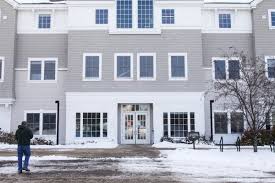
   

“First, take The McLellan.  We see real opportunity here, with hidden quality problems and obscenely expensive to operate mechanical systems.”  He referred us to this background info on the building (http://www.oaconstruction.com/mclellan-building.aspx):

This three-story, multi-purpose building is home to Bowdoin College offices, conference rooms, computer training labs, art studios, photographic dark rooms and storage space. The building is fully air-conditioned and features high-efficiency windows throughout.

Challenges to construction included the presence of coal ash on the site, leftover from the days of steam locomotives. The team had to encapsulate the ash before construction could begin. Then, steel piles had to be driven into bedrock to support a foundation that included 118,000 pounds of steel reinforcement to ensure structural integrity.

Set in a predominantly residential neighborhood, the shingle and clapboard building, with its intricate window trim, blends in well with its surroundings. 

He sent us some photos that reveal the kind of ‘aftermarket’ opportunities Construction Fiasco will home in on.

      DSC_0114  DSC_0113

“You know the old saying about high-efficiency windows and intricate window trim…..as our CFO, K.A. Ching says, you can’t expect these things to last forevert, and just how long do you expect to be able to see through them?”

“Next,” he told us, “there’s the Cooks Corner Fire Station.”


“This building was designed to last,” Howie added, referring us to this descriptive info:

The challenges: This project was the result of a design competition, sponsored by the Town of Brunswick. Ouellet Associates stressed the importance of longevity—constructing a building that could serve the community into the next century. To meet these goals we selected durable building materials that will require minimal maintenance.

(We confess to being in a quandary as to what ‘into the next century’ might mean when you build a facility in 2005/2006, but why pick nits?)

One man’s longevity is another man’s opportunity we suppose.  Apparently some ‘anomalies’ have surfaced at the Fire Station, as described in this report: http://www.scribd.com/doc/219739118/Wright-Pierce-report-on-Cooks-Corner-Fire-Station.

“Besides fixing those problems, we think the kitchen could use some updating to make it show better, and it’s not up to date with the latest fire codes.  Besides, the color scheme doesn’t reflect the chicest decorating trends, and we think it’s important to keep staff morale as high as possible.  So we’re proposing a new palate to bring crew quarters into this decade.”

On Sept. 25, a large crowd gathered outside to celebrate the opening of Brunswick's new police station on the corner of Pleasant and Stanwood streets.

Dewie went further, adding “we’re proposing to be put on retainer to deal with problems at the new  Police Station, once the inevitable occurs.”

“We’re looking for a proven local business consultant and a prominent, connected attorney to help us set up the deal,” he noted.  “We’ll even pay to have our company logo added on Brunswick Taxi vehicles.”

The Cheathams cited missed opportunities in the past that drove them to conceive this opportunity based enterprise.  They mentioned the local Post Office, which has spent at least 6 months on front step repair and ramp replacement.  “We would gladly have spread that work out over a longer time frame…say a year….to allow local residents to become more familiar with our work.  And it would have given us more time to meet our new neighbors.”

They also emphasized the importance of making critical renovations before buildings are demolished.

“The Old High School got away from us; we were just a germ of an ideal when it went down.”

“But look at the lesson the town learned with the old Times Record Building.  They bought it for $1.3 million, and quickly realized it would need a good half a million in improvements before it could safely be torn down and the site cleaned up,” the Cheathams pointed out.

“Now the town wants to tear down the Jordan Acres School, but it’s in no condition to be safely demolished.  You can’t risk the health and welfare of your employees in a job like this.  We’re confident we can repair the major structural and cosmetic problems to ensure a safe and TRS certified building removal,” Howie said.

The brothers have their eyes on the Federal Street municipal campus as well.  The existing Rec Center and now vacated Town Hall are slated for the wrecking ball to make way for a new building to house CEI offices.


“We see it as a matter of community self-esteem to have both buildings in tip-top shape before they’re wiped from the earth.  Proper staging and curb appeal are ultra-important when undertaking such an operation in a historic down-town neighborhood.  The buildings deserve to be treated with respect, and the neighbors as well.  Letting go, closure, and all the other civic anxieties come into play.  Done right, we think it can be handled as a celebration of Brunswick’s Downtown vitality, complete with appropriate festivities.”

“As you can see, our plate is pretty full right at the git-go,” K.A. Ching said, “but we’re already incorporating HBS School, the High School, and Maine Street Station buildings into our long range strategic plan.  It’s only a matter of time before our kind of expertise becomes a necessity, and we want to partner with the community as closely as we can.”


“That’s why we’re busy pursuing an unfair advantage in these important community pursuits.  In matters like these, where civic identity and esteem is at stake, it’s important not to let the recklessness of the competitive free market distort priorities.”

The firm is using all the local influence available to them to push for a $600,000 initial grant from the Brunswick Development Corporation, well known venture capital source for those with the right connections.

“We promise that our use of those funds will provide local jobs, and the more we’re given, the more jobs we can create.  The sky’s the limit from what we can see,” the CFO reminded us.

Suddenly warm memories of MRRA creating 17,000 jobs at the old Naval Air Station came rushing back.

As we ended our conversation, the Cheathams told us they were thinking of “Construction Now, Quality Whenever” as their corporate motto.  “How do you like it,” they asked.

We allowed as how it certainly seemed to capture the essence of Brunswick, at least in one important area.